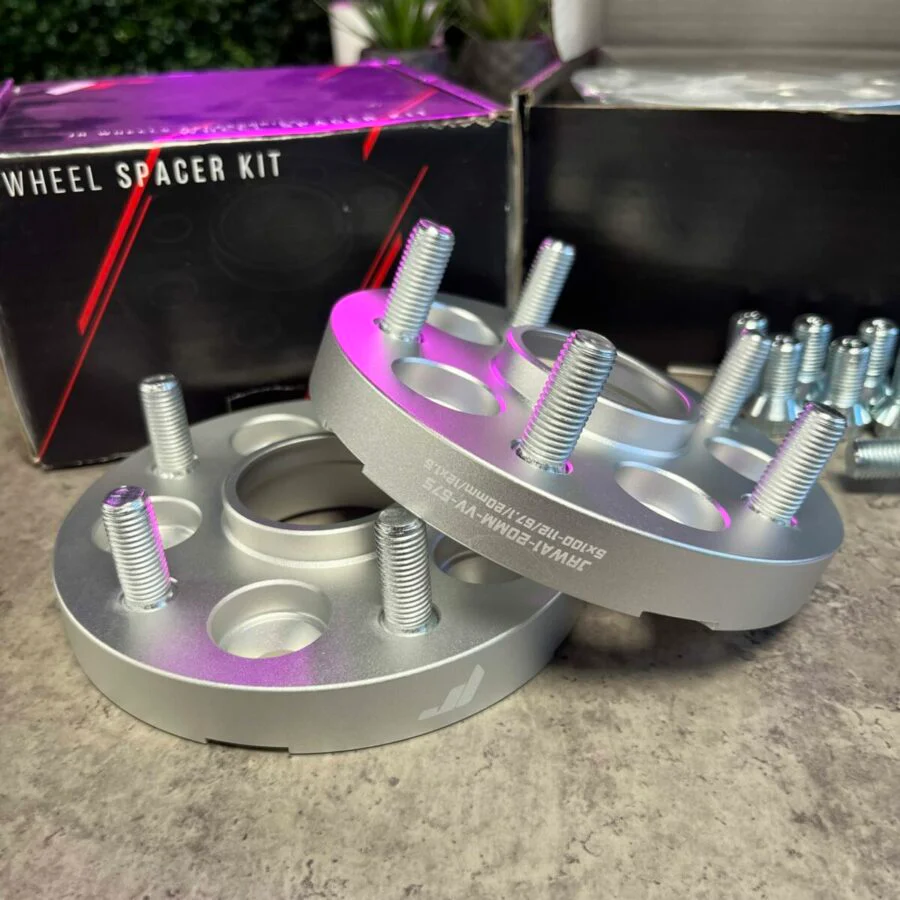
Most people start with wheel spacers.
That makes sense. They’re simple, widely available, and solve a very specific problem – pushing the wheel outward to improve stance or clear suspension components.
But in real-world builds, especially once you move beyond standard setups, spacers are often not enough.
At some point, you run into a more fundamental issue: the wheel simply doesn’t fit the car.
And that’s where things start to get misunderstood.
Why Spacers Don’t Always Work
A spacer does one job well: it moves the wheel further away from the hub.
What it doesn’t do is change how the wheel mounts.
That means it cannot solve:
- Bolt pattern (PCD) mismatch
- Centre bore differences
- Stud or bolt compatibility
- Clearance issues caused by long studs
If your wheel already matches your car, spacers are a clean solution.
If it doesn’t, you need something else entirely.
The Real Problem: Fitment Geometry
Wheel fitment isn’t just about size or offset.
It’s about how three critical interfaces line up:
- The hub
- The mounting face
- The wheel
Each of these has fixed dimensions.
When those don’t match, you physically cannot mount the wheel correctly.
That’s where PCD hub adapters come in.
What Hub Adapters Actually Do
A hub adapter sits between the car and the wheel, creating a new mounting interface.
In simple terms:
Hub → Adapter → Wheel
This allows you to:
- Convert between different PCDs
- Match centre bore dimensions
- Change from bolt to stud setups (or vice versa)
Unlike spacers, PCD hub adapters are solving a fitment problem, not just adjusting position.
For anyone dealing with cross-brand wheels or custom builds, this is often the only workable solution.
Where It Gets Complicated: PCD Overlap
This is where most generic advice falls apart.
Not all PCD conversions are straightforward.
Some combinations create a situation where the bolt holes physically clash.
For example: trying to machine two different bolt patterns into a single adapter can result in:
- Holes sitting too close together
- Holes partially overlapping
- Not enough material between fasteners
At that point, it’s no longer just a design challenge — it becomes a structural problem.
There simply isn’t enough material to safely support the load.
And this is why some adapters can’t be made as a single piece.
The Solution: Two-Piece Hub Adapters
When bolt patterns overlap, the only correct solution is to separate them.
This is done using a two-piece design:
- The inner section mounts to the hub
- The outer section carries the wheel bolt pattern
By splitting the interfaces, you avoid:
- Hole overlap
- Weak material sections
- Compromised clamping force
From an engineering standpoint, this is not an upgrade or a premium option.
It’s a necessity when the geometry demands it.
Real-World Example: When This Actually Happens
A common scenario is trying to run Audi wheels (5×112) on a BMW hub (5×120).
On paper, this looks simple: just use a PCD conversion adapter.
In reality, depending on the exact dimensions, the bolt holes for these two patterns can sit too close together to safely machine into a single piece.
When that happens:
- The holes either overlap or nearly overlap
- There isn’t enough material between them
- The adapter becomes structurally compromised
This is where a two-piece hub adapter becomes necessary.
Instead of forcing both patterns into one component, the design separates them completely, maintaining strength and proper load distribution.
Another Common Issue: Stud Length
There’s another problem that comes up regularly — and it’s often overlooked.
Stud length.
On some vehicles, wheel studs can extend 25–40mm past the hub face.
If you install an adapter that’s thinner than that:
- The studs bottom out inside the adapter
- The adapter cannot sit flush
- Load is no longer evenly distributed
At that point, even a perfectly machined part won’t function correctly.
You’re dealing with a basic clearance issue.
The only real solutions are:
- Increase adapter thickness
- Or modify the studs
This is one of the main reasons off-the-shelf parts often don’t work in more complex setups.
Why Custom Adapters Are Often Required
Once you combine:
- PCD mismatch
- Centre bore differences
- Stud protrusion
- Required thickness
You end up with a very specific set of constraints.
There is no universal solution.
Every dimension affects another part of the design.
That’s why many builds end up needing something bespoke rather than generic.
If you’re dealing with overlapping bolt patterns or unusual fitment requirements, it’s worth looking at a proper custom PCD adapter solution rather than trying to make a standard part work.
The Difference Between “Fits” and “Works Properly”
This is where a lot of problems come from.
A setup can physically bolt together and still be wrong.
The key factors that actually matter are:
- Flat mounting surfaces
- Correct clamping force
- Proper thread engagement
- Even load distribution
If any of those are compromised, you’re not dealing with a proper solution — just something that appears to fit.
And in wheel fitment, that distinction matters.