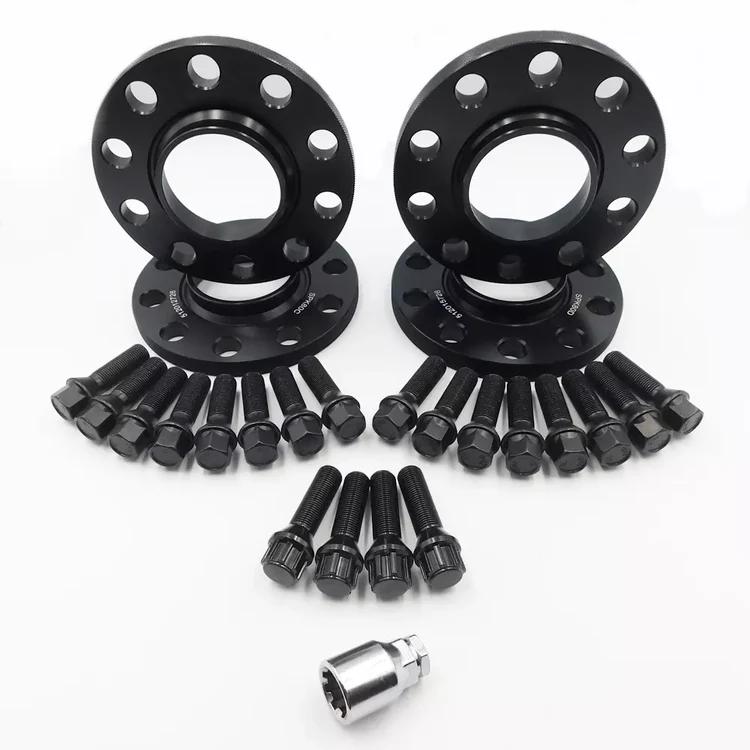
Let’s start with the obvious question.
You want better fitment. You want the wheels to sit properly. You’ve seen other cars with a wider stance and thought, that looks right.
So you search for wheel spacers.
Then you hit the problem.
12mm? 15mm? 20mm? What do you actually need?
Most people guess. That’s where things go wrong.
In this post, I’ll walk through how to choose the right wheel spacer thickness without guessing, based on how I approach it as someone who designs and machines these parts.
What Wheel Spacer Thickness Actually Changes
Before choosing a thickness, you need to know what it does.
A wheel spacer moves the wheel away from the hub. That’s it.
But that simple change affects three key things:
- How the car looks (stance)
- Clearance to suspension and brakes
- Thread engagement on the bolts or studs
For example, a 12mm spacer will push the wheel out by 12mm. A 15mm spacer pushes it out by 15mm. Sounds simple, and it is.
But small changes make a big difference once the wheel is close to the arch.
First: Check Your Current Fitment
Before buying anything, look at your current setup.
You need to answer one question:
How far is your wheel sitting inside the arch right now?
You can check this in a few ways:
- Stand above the wheel and look straight down
- Use a straight edge across the arch and measure the gap
- Take a photo and assess visually
For instance, if your wheel sits 10–12mm inside the arch, then a 12mm spacer will bring it close to flush.
If it sits deeper, you may need 15mm or more.
This step removes most of the guesswork.
Then: Think About Your Goal
Not everyone wants the same result.
So next, decide what you actually want.
Flush Fitment
This is what most people aim for.
The wheel sits level with the arch. Not sticking out, not tucked in.
In most cases:
- 12mm to 15mm works well on the front
- 15mm to 20mm works well on the rear
But it depends on the car.
Aggressive Fitment
Some people want the wheel slightly past the arch.
That usually means:
- 15mm to 20mm front
- 20mm+ rear
You need to be more careful here because clearance becomes tighter.
Functional Clearance
Sometimes the goal is not looks.
For example:
- Clearing larger brake calipers
- Fixing inner arch rubbing
In that case, you choose the minimum spacer that solves the problem.
Thread Engagement: Where Most People Get It Wrong
This is the part people ignore.
When you add a spacer, you reduce how much thread the bolt engages into the hub.
Less engagement = less safety margin.
Here’s a simple rule:
- You want at least 6.5 to 8 full turns of engagement on most M14 setups
So:
- 12mm spacer → usually safe with slightly longer bolts
- 15mm spacer → requires longer bolts
- 20mm+ spacer → often better with bolt-to-hub or stud conversion spacers
If you get this wrong, you won’t notice straight away. But over time, it can cause serious problems.
Spacer Type Matters (Not Just Thickness)
Thickness alone is not enough.
The design matters just as much.
There are two main types:
Straight-Through Spacers (Longer Bolts)
Used for thinner spacers.
Simple design. Lower cost.
But:
- You rely fully on longer bolts
- More chance of incorrect setup
Bolt-to-Hub Spacers
These bolt to the hub first, then the wheel bolts to the spacer.
This is where things get better.
- Full thread engagement is maintained
- Safer for thicker spacers
- More consistent fitment
This is why I generally recommend hubcentric wheel spacers rather than generic ones:
They locate properly on the hub and reduce the chance of vibration.
Real Example: Porsche Fitment
Let’s make this practical.
Take a typical Porsche setup.
From factory, many models sit slightly tucked in at the rear.
A common setup would be:
This gives:
- Balanced stance
- No rubbing (on standard suspension)
- Good thread engagement when using the correct spacer type
If you’re running a Porsche and want a known good starting point, this is where I’d begin:
From there, you can adjust based on your exact setup.
Common Mistakes to Avoid
I see the same issues again and again.
Guessing Based on Forums
Someone says “I run 20mm all round”.
That might work on their car.
It might not work on yours.
Ignoring Suspension Setup
Lowered cars need more care.
Less clearance means less margin for error.
Mixing Cheap Spacers with Good Hardware
Bad tolerances cause vibration.
Poor materials wear faster.
You feel it through the steering wheel.
A Simple Way to Get It Right
If you want a quick method, follow this:
- Measure how far your wheel sits inside the arch
- Decide your target (flush or aggressive)
- Choose the thickness that matches that gap
- Check thread engagement
- Choose the correct spacer type
That’s it.
No guesswork.
Final Thoughts
Choosing the right wheel spacer thickness is not complicated.
But it does require a bit of thought.
Most problems come from guessing or copying someone else’s setup without checking the details.
If you measure your current fitment, set a clear goal, and match the spacer to that, you will get it right first time.
And once it’s right, it transforms how the car sits and feels on the road.